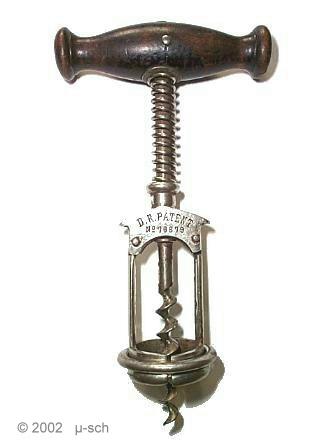
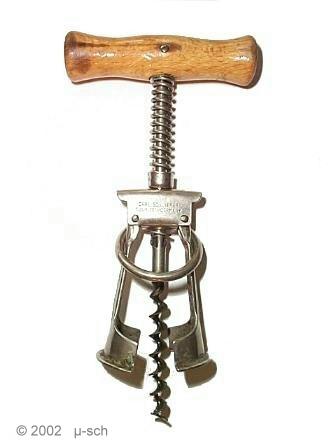
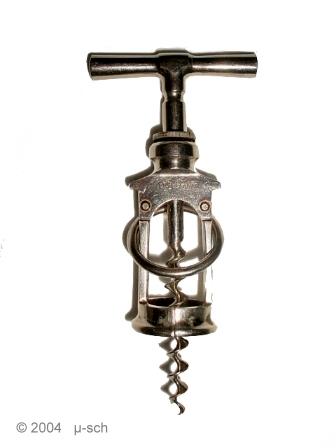
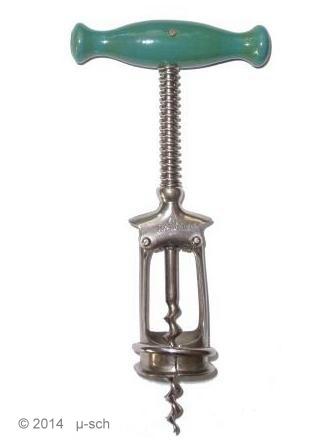
In 1893, Eduard Becker of Solingen, Germany, invented a corkscrew with a split frame to facilitate removal of the extracted cork from the worm. The spring assists the extraction by exerting pressure.
Deutsches Reichs Patent
D.R.P. No. 70 879
by Eduard Becker, Solingen
in March 7th, 1893.
material: steel, wood
marking:
D.R.PATENT No 70879
COLUMBUS
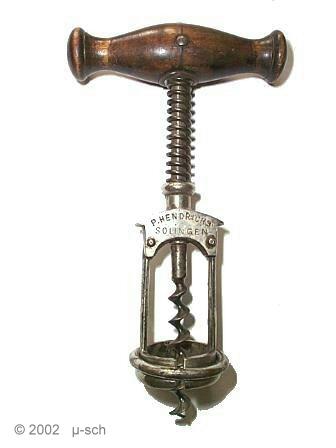
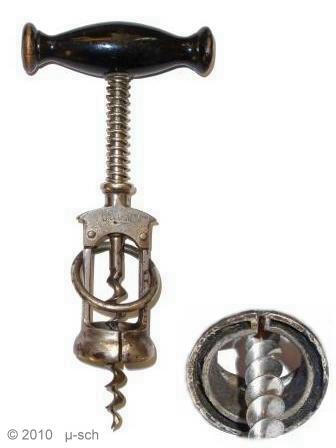
Another corkscrew with a split frame.
The difference to the above item is the marking.
material: steel, wood
marking:
COLUMBUS
D.R.P. No 70879
P. Hendrichs
Solingen
I'm not sure if the marking is only an advertisement or the name of the Company.
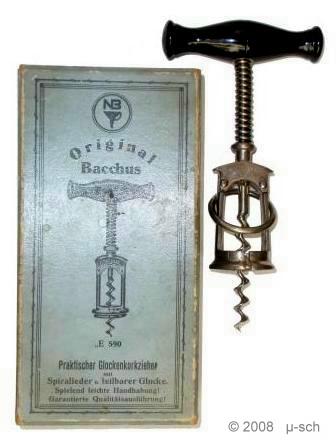
This corkscrew is allthough different to the above.
1st. The finishing nail is extending lengthwise through the handle.
2nd. The frame is secured with two stamped noses on the shaft. (above with a ring).
material: steel, wood
With original carton
marking:
ORIGINAL - BACCHUS
NB with a funnel
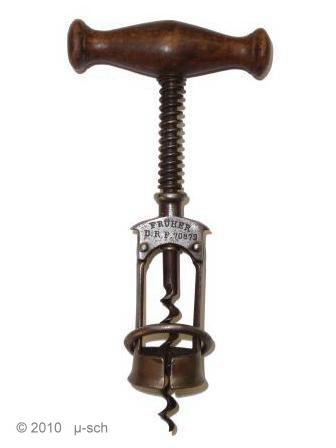
The difference here is, that the two pieces of the split frame are made out of tin.
???? Registered for
Gustaw Twellsiek, Solingen, Germany
on January 6th, 1910.
D.R.G.M. No. 407 605 ????
material:steel, wood
marking:
COLUMBUS
FRÜHER D.R.P. 70879
Another COLUMBUS with another difference.
Split-frame corkscrew with a crossbar (bridge) made from tin out of 1 piece.
D.B.G.M. No. 1 602 755
July 29, 1949
Karl Breithof Söhne, Solingen, Germany
material: steel, wood
marking:
Symbol (sun)
Carl Schlieper, Solingen-Germany
The brackets of this split frame are different. The grooves were probably designed to hold rubber rings to protect the bottle neck.
German Registration
D.R.G.M. No. ?
material: steel, wood
marking:
Original
D.R.G.M.
Corkscrew with an open, splitable frame. For using the corkscrew you move the ring down. After using you can move the ring up and split the frame in two pieces. Than you can turn off the cork easier.
D.R.G.M. No. 405 690
Dec. 23, 1909
Gg. Hermann Usbeck, Steinbach-Hallenberg i. Th., Germany
material: steel
marking:
Monopol 117 + DRGM
Another COLUMBUS with another difference.
Split-frame corkscrew with a crossbar (bridge) made from tin out of 1 piece.